SEPA Payments
What is SEPA?
SEPA (Single Euro Payments Area) is a European payment integration initiative that enables individuals and businesses to make cashless euro payments across borders as easily, quickly, and securely as domestic payments.
SEPA standardizes:
Payment formats
Rules
Timelines
Rights and obligations
Key idea:
A SEPA payment from France to Germany should feel the same as a domestic payment within France.
Countries Involved in SEPA
SEPA covers 36 countries, including:
EU Member States (27)
Germany, France, Italy, Spain, Netherlands, Belgium, Austria, Portugal, Ireland, Finland, Sweden, etc.
Non-EU SEPA Countries
United Kingdom
Switzerland
Norway
Iceland
Liechtenstein
Monaco
San Marino
Andorra
Vatican City
Important:
All SEPA payments are EUR-only, even if the country’s local currency is different.
Regulatory & Governance Bodies
European Central Bank (ECB) – Oversight & monetary policy
European Payments Council (EPC) – Defines SEPA rulebooks
European Commission – Regulatory framework
National Central Banks (NCBs) – Local oversight
SEPA Payment Schemes
SEPA supports the following payment schemes:
SEPA Credit Transfer (SCT)
Standard euro credit transfer
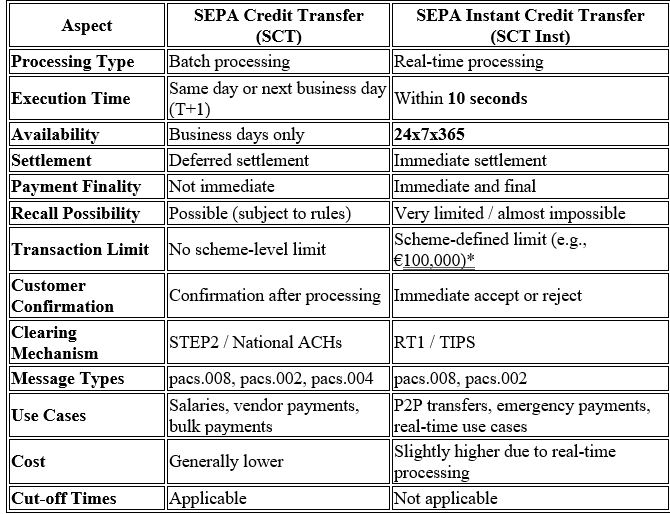
T+1 settlement
Used for salaries, vendor payments, transfers
SEPA Instant Credit Transfer (SCT Inst)
Real-time payments
Available 24x7x365
Settlement within 10 seconds
SEPA Direct Debit (SDD)
Consumer (SDD Core)
Business-to-business (SDD B2B)
SEPA Payment Message Standards
SEPA uses ISO 20022 XML messages.
Customer-to-Bank Messages
pain.001 – Credit transfer initiation
pain.008 – Direct debit initiation
Interbank Messages
pacs.008 – Customer credit transfer
pacs.002 – Payment status
pacs.004 – Payment return
pacs.007 – Recall / request for cancellation
Bank-to-Customer Reporting
camt.052 – Intraday statement
camt.053 – End-of-day statement
camt.054 – Credit/debit notification
SEPA Clearing & Settlement
Clearing
Exchange of payment messages
Validation and routing
Calculation of net positions
Settlement
Actual movement of funds
Occurs in central bank money
Typically via TARGET2
Popular SEPA Clearing Mechanisms
STEP2 (pan-European ACH)
RT1 (Instant payments)
National ACHs (e.g., STET, Equens)
SEPA Credit Transfer (SCT) – Detailed Flow
Happy Flow
Customer → Ordering Bank → Clearing Mechanism → Beneficiary Bank → Beneficiary
Steps:
Customer submits payment (pain.001)
Ordering bank validates & converts to pacs.008
Clearing routes the payment
Beneficiary bank credits the account
Confirmation sent (pacs.002 / camt.054)
Settlement: T+1
Currency: EUR only
SEPA Instant Credit Transfer (SCT Inst)
Key Characteristics
Execution time: ≤10 seconds
Available 24/7
Max transaction limit (scheme-defined)
Immediate confirmation or rejection
Instant Flow
Payer → Bank A → RT1/TIPS → Bank B → Payee
If beneficiary bank does not respond within SLA → automatic reject
SEPA Workflows Explained
Happy Path
Payment processed successfully
Funds credited to beneficiary
Final and irrevocable (especially SCT Inst)
Reject Workflow
Occurs before settlement
Common reasons:
Invalid IBAN
Account closed
Insufficient funds
Technical validation errors
Payment → Validation Fails → pacs.002 Reject → Customer Notified
Return Workflow
Occurs after settlement
Typical reasons:
Wrong beneficiary
Account does not exist
Regulatory issues
Settled Payment → pacs.004 Return → Funds Reversed
Recall Workflow
Request to cancel or retrieve funds
Not guaranteed
Beneficiary bank consent required
Recall Request (pacs.007) → Beneficiary Bank → Accept / Reject
In SCT Inst, recall is very limited due to immediate settlement.
Why SEPA Knowledge Is Important (Interview Perspective)
Interviewers expect you to:
Explain end-to-end SEPA flows
Understand ISO 20022 messages
Differentiate SCT vs SCT Inst
Handle exceptions & investigations
Explain real project challenges
Key SEPA Terminologies
1. SEPA (Single Euro Payments Area)
A European initiative that enables standardized euro payments across participating countries, treating cross-border payments like domestic ones.
2. SCT (SEPA Credit Transfer)
A standard euro credit transfer scheme used for non-urgent payments, typically settled on T+1.
3. SCT Inst (SEPA Instant Credit Transfer)
A real-time euro payment scheme that processes payments within 10 seconds, available 24x7x365.
4. EPC (European Payments Council)
The governing body responsible for defining SEPA rulebooks, standards, and compliance guidelines.
5. IBAN (International Bank Account Number)
A standardized account identifier used in SEPA payments to uniquely identify the payer and beneficiary accounts.
6. BIC (Bank Identifier Code)
A SWIFT code used to identify banks in cross-border payments (optional for some SEPA transactions).
7. CSM (Clearing and Settlement Mechanism)
The infrastructure that routes, clears, and settles SEPA payments between banks.
8. TARGET2
The real-time gross settlement (RTGS) system used for settlement of SEPA payments in central bank money.
9. RT1
A pan-European real-time clearing system used specifically for SEPA Instant payments.
10. TIPS (TARGET Instant Payment Settlement)
An ECB-operated system that provides instant settlement for SEPA Instant payments in central bank money.
11. ISO 20022
The global XML-based messaging standard used for SEPA payments (e.g., pain, pacs, camt messages).
12. pain.001
Customer-to-bank message used to initiate SEPA Credit Transfers.
13. pacs.008
Interbank message used to process SEPA credit transfers between banks.
14. pacs.002
Payment status message indicating acceptance or rejection of a transaction.
15. pacs.004
Message used to return a SEPA payment after settlement.
16. pacs.007
Message used for recall or cancellation requests.
17. camt.052
Intraday account statement used for real-time liquidity monitoring.
18. camt.053
End-of-day account statement for reconciliation.
19. camt.054
Credit or debit notification sent to customers.
20. R-Transactions
A collective term for Reject, Return, Recall, and Refund scenarios in SEPA.
21. Cut-off Time
The deadline by which payments must be submitted to be processed on the same business day (applies mainly to SCT).
22. STP (Straight Through Processing)
Payments processed automatically without manual intervention, improving speed and accuracy.
23. Value Date
The date on which funds become available to the beneficiary.
24. Liquidity Management
Ensuring sufficient funds are available in settlement accounts to process SEPA payments without delays or failures.
25. UETR (Unique End-to-End Transaction Reference)
A unique identifier used to track payments end-to-end (more prominent in SWIFT but referenced in SEPA tracking).
Why These Terminologies Matter
Interviewers and project stakeholders expect you to:
Speak confidently using SEPA terminology
Explain end-to-end payment flows
Handle exceptions and investigations
Understand clearing, settlement, and compliance
SCT vs SCT Inst – Comparison
* Transaction limits may vary based on scheme and participant bank policies.