Payments Introduction
Payments are the backbone of the banking ecosystem. Every time money moves from one account to another—whether through mobile banking, internet banking, or corporate systems—a funds transfer process is triggered behind the scenes.
This page explains how payments work end-to-end, supported by simple flow diagrams to help you visualize the process clearly.
What Is a Funds Transfer?
A funds transfer is the electronic movement of money from a sender’s account to a beneficiary’s account. The transfer may occur:
Within the same bank
Between different banks
Across countries and currencies
Even though the customer experiences it as a single action, multiple systems collaborate to complete the transaction securely.
High-Level Funds Transfer Flow (Overview Diagram)
This is the simplest view of how money flows from one party to another.
Step-by-Step Funds Transfer Flow (Detailed Explanation)
Let’s break this down further.
Step 1: Payment Initiation
The customer initiates a payment using:
Mobile banking
Internet banking
Branch
Corporate file upload or API
What happens:
Payment details are captured
Instruction is sent to the bank’s payment system
Customer App → Payment Instruction Created
Step 2: Validation and Authorization
Before processing the payment, the bank performs critical checks:
Account balance validation
Authentication & authorization
Compliance checks (sanctions, AML)
Format and rule validation
Payment Instruction → Validation Engine (Balance | Compliance | Rules)
If validation fails, the payment is rejected immediately.
Step 3: Payment Message Creation
Once validated, the bank converts the instruction into a standardized payment message.
This message contains:
Sender and beneficiary details
Amount and currency
Settlement instructions
Validated Payment → Standard Payment Message
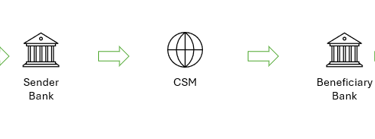
Inter-Bank Payment Flow (Key Diagram)
When the sender and beneficiary banks are different:
Sender Bank → Payment Message → Clearing / Payment System → Cleared Instruction → Beneficiary Bank
Banks exchange messages, not physical money.
The actual money movement happens later during settlement.
Step 4: Clearing Process
Clearing is the process of:
Exchanging payment messages
Calculating net positions between banks
Preparing settlement instructions
Multiple Banks → Clearing System (Net Positions Calculated)
This step ensures accuracy and efficiency, especially for high transaction volumes.
Step 5: Settlement Process
Settlement is when real money moves between banks using settlement accounts (usually held with a central bank).
Sender Bank Account → Settlement System → Beneficiary Bank Account
Once settlement is completed, banks are financially squared off.
Step 6: Posting and Confirmation
After settlement:
Beneficiary bank credits the customer’s account
Confirmation is sent back to the sender’s bank
Customer receives success notification
Beneficiary Bank → Beneficiary Account Credited → Customer Notified
Intra-Bank vs Inter-Bank Transfer (Comparison Diagram)
Intra-Bank Transfer
Customer A → Same Bank → Customer B
✔ Faster
✔ No clearing system involved
Inter-Bank Transfer
Customer A → Bank A → Clearing → Bank B → Customer B
✔ More checks
✔ Clearing and settlement required
Key Components of a Payments Ecosystem
Channels → Core Banking → Payment Engine → Clearing → Settlement → Posting
Each component plays a specific role in ensuring:
Security
Accuracy
Compliance
Speed
Why These Flows Matter (Interview & Real-World Relevance)
Understanding payment flows helps you:
Explain end-to-end payment processing in interviews
Identify failure points (rejections, reversals, delays)
Design better payment solutions
Communicate effectively with tech, ops, and compliance teams
This knowledge is essential for Business Analysts, Product Owners, Scrum Masters, and Payments professionals.
Key Takeaway
A funds transfer is a multi-step, message-driven process involving validation, clearing, settlement, and posting. While customers see a simple transaction, banks execute a complex and well-controlled workflow to ensure money moves safely and correctly